

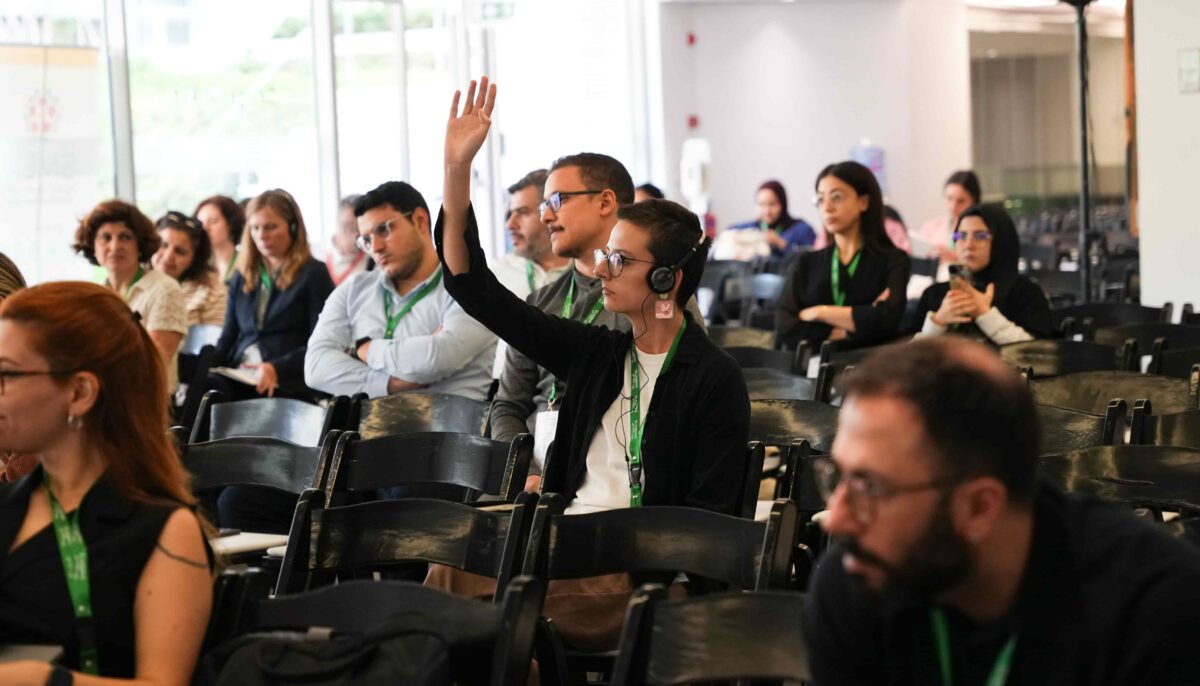
Bread&Net took place in Beirut in October 2025, bringing together more than 550 participants from across the West Asia and North Africa (WANA) region and beyond. Since then, the political conditions in which the gathering happened have not eased; far from it, they have intensified.
After more than two years without an in-person edition, the return of Bread&Net in Beirut created space for reconnection, coordination, and long-term thinking across the digital rights movement. Participants from all over the WANA region came with more experience, precise technical skill and a clear understanding that digital rights work in the region is no longer peripheral, but central to struggles over power, safety, and accountability in the online sphere.
What defined Bread&Net 2025?
What truly sets Bread&Net apart is its people, those who return year after year, those joining for the first time, and those who see this space as part of their activism and professional home.
The gathering took place amid the ongoing wars in the region, which paved the way for crucial conversations about surveillance, spyware, and corporate-enabled human rights abuses. Similarly on a global scale, the gathering happened in the middle of major funding cuts affecting civil society and an increasingly hostile political climate.
The hostile global political climate paired with the rapid advance of malicious technologies pushed our community to want to take action. Recognizing the growing danger of AI, the militarization of technology, and surveillance, participants arrived with sharper analysis, stronger technical capacity, and a shared understanding that digital rights work must move faster and coordinate better to respond to these accelerating threats.
“Bread&Net provides space to rethink how technology is linked to development in our region, and what is missing. After the momentum we witnessed, we are looking forward, with a human-centered and hopeful vision, to opening new horizons toward building a more just future,” said Mohamad Najem, SMEX’s Executive Director.
Strengthening the foundations of the digital rights movement
The first day focused on strengthening the foundations of the movement. Participants discussed resilient organizing, reaffirming that digital rights work in the region must remain people-centered and accountable to affected communities.
Day two shifted toward practice and coordination. The sessions discussed emerging digital threats, misinformation ecosystems, and the targeting of activists and journalists, while exploring tools and cross-regional collaboration to build safer digital spaces.
The final day focused on how organizations can grow without compromising values or political integrity, and on the need for flexible funding and long-term movement alliances. Many sessions also focused on the need to critically use AI technologies.
During Bread&Net, many sessions focused on digital rights from a feminist perspective; emphasizing on the fact that gender and online violence are often interlinked and affect each other. Participants took part in sessions on feminist activism, blackmail and censorship, as well as the creation of political spaces for women.
As the wars in Lebanon and Gaza have made digital security a frontline issue for journalists, the online protection of journalists and activists emerged as a timely and important topic. Concerns around the protection of journalists moved beyond the scope of freedom of expression and physical safety to their digital and online wellbeing.
Sessions also brought up the state of freedom of expression in the world and specifically in the WANA region. The gathering brought together journalists, activists, and media professionals to discuss their challenges in the face of repressive laws and lack of protection.
The current state of telecommunication in Lebanon was extensively discussed in a panel, bringing together telecom sector Wassim Mansour and public figures, namely MPs Paula Yacoubian and Yassine Yassine who have been working alongside SMEX on recommendations to enhance the sector.
SMEX alongside Internet Society also offered a three-hour intensive course on internet governance—a main discussion that happened during the gathering. The course was also complemented by prior introductory sessions such as “Internet Governance 101” and other sessions on digital safety and security.
Finally, AI literacy emerged as essential. Participants critically examined AI imperialism, corporate power, privacy, and automated surveillance, stressing that AI must be understood as part of a political infrastructure emanating from power and control.
Across all three days, Bread&Net 2025 reaffirmed its role as a hub for a community-led digital rights movement. With that in mind, we hope in the new year to keep the momentum going and further engage you with Bread&Net in 2026. We absolutely cannot wait to share all the ideas we have for our upcoming edition!