

Every few months, a new AI image trend takes over social media. In early 2025, millions uploaded their photos to AI chatbots to get a Studio Ghibli-style portrait. By Ramadan 2026, the trend turned devotional with people decorating their photos with lanterns, calligraphy, and more.
Another trend pushed users to prompt ChatGPT with “create a caricature of me and my job based on everything you know about me.” Trends continue to emerge, asking AI chatbots to utilize personal information and handback something shareable.
The most immediate reason for limiting the sharing of personal images and sensitive information with AI chatbots is privacy protection, for people in West Asia and North Africa, the regional context adds another layer of risk. Add to that a track record of serious controversies: AI chatbots have “hallucinated” false information and presented it as fact, been deployed in military targeting systems, and spurred out user information even after they opt out or adjust their setting.
AI companies including OpenAI, Anthropic, and Google, have all been involved in a way or another in militarizing their technology, like rendering services to militaries or governments, putting people in the WANA region at a special increased risk for the use of AI chatbots.
Each of these trends follows the same pattern: a fun, shareable premise, and millions voluntarily hand over their photos, their names, their jobs, and their personal details to AI platforms, often without considering how this information is being used, stored, or with whom it is being shared.
So, should you upload a photo of yourself on an AI platform like ChatGPT, Claude, or Gemini? The short answer is no, and here’s why.
AI agents could profile you
Unlike filters or avatars built into social platforms, these AI tools often require users to voluntarily provide detailed inputs, high-quality images, descriptive prompts, and contextual information that, taken together, form a startlingly complete profile about you.
The risk is not any single prompt, but an accumulation of all the information it has on you. Hobbies, work roles, family references, and daily routines can be pieced together like a puzzle, forming a map of your life.
Text alone can lead to the collection of sensitive information. Upload a photo and the risk increases, as it may contain additional personal or identifying details.
“AI chatbots process your pictures like a powerful surveillance camera,” explains Madeleine Belesi, a senior cybersecurity analyst at SMEX. “The chatbot analyzes the small details of your face, potentially paving the way for bigger, more powerful AI systems to recognize you using your unique features.”
AI uses that data. What users upload is used to train their models to be more accurate and more powerful. In that sense, when you upload an image into a chatbot, you are teaching it to learn the features of your face and your life. It can use this information to potentially generate future outputs using this information. So if someone later asks the chatbot to generate an image of a person in a specific setting, the chatbot may use the data you provided, including your face, to generate a new output.
AI-powered facial recognition and targeting systems have already been documented in conflict zones. Tools like Israel’s Lavender, and the involvement of major AI companies in military contracts, have raised serious alarm among human rights organizations, both over the tool and the AI companies whose contracts make it possible.In authoritarian contexts, facial recognition technology has become a tool for mass surveillance and social control used to monitor protests, track individuals, and suppress dissent.
Voluntarily submitting your face to an AI platform, especially one based in a foreign jurisdiction with opaque data-sharing agreements, carries risk for anyone living in a politically sensitive situation.
OpenAI’s privacy policy states that they “collect Personal Data that you provide in the input to our Services (“Content”), including your prompts and other content you upload, such as files, images, audio and video.”
Other commonly used chatbots like Google’s Gemini, Anthropic’s Claude, and Deepseek also have rules on how they collect and use your data, and you should always review those to verify how this information is used.
Images you upload from your devices often carry metadata, which is essentially ‘information about your data’ extracted through the image you uploaded, like your location, the time it was taken, the device it was taken from, and other details that may be sensitive depending on your context.
Metadata can be incredibly valuable to malicious actors, as it may enable them to build detailed profiles of individuals or organizations and conduct surveillance or reconnaissance activities.
Their privacy policy has also mentioned that even after you turn off training using their opt-out feature, your chats can continue to exist in your account’s history and are stored for 30 days if you use the “temporary” feature.
What do children risk?
Parents routinely upload photos of their children to join these trends. The intention is not malicious, but a child is not an individual capable of informed consent.
When a parent uploads a child’s photo to an AI agent, that child has not agreed to anything. They do not know their image is being stored on a company’s servers or potentially reviewed by human moderators.
The uncertainty is the point. We cannot know today how this data will be used in 10 or 15 years, what systems it might feed into, what governments or companies might one day have access to it, or what kind of person the child will grow up to be and what risks they might face.
The UN has warned at the beginning of this year of the risks associated with children using AI; emphasizing that they may particularly face cyberbullying, harassment, grooming and deepfakes—all having the potential to translate into physical harm.
What SMEX recommends
As a digital rights organization focused on privacy, we always recommend limiting the amount of information you share on any online service, including AI chatbots. But with AI, we recommend extra caution. AI chatbots like ChatGPT have features you can enable to partially preserve your privacy.
For example, you can opt out of the option to use your data to improve their models to train their chatbots.
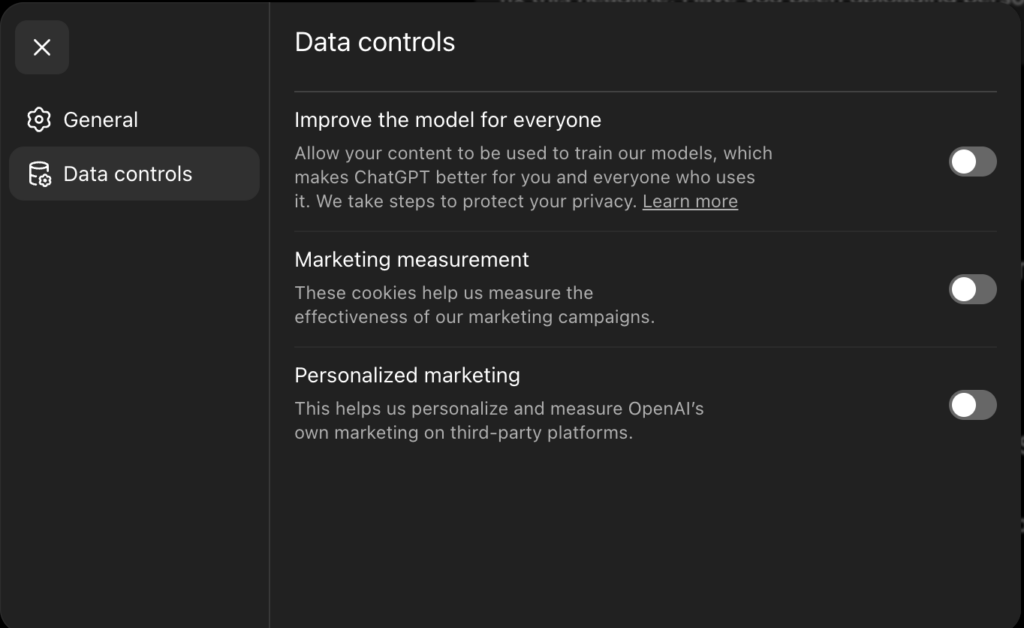
You should also turn off the toggles related to marketing, as these could use metadata provided by the images you upload or the information you give the chatbot.
Where possible, review the app’s permissions in your device or platform settings and restrict them to only what is necessary. Grant permissions only while the app is in use whenever that option is available.
We also recommend that where possible, to use the chatbot while signed out, meaning avoid logging in using your credentials.
Opting out usually stops your prompts from being added to future model training, but it doesn’t instantly scrub your data from backend processing queues, backups, human reviewer logs, or CDN transit caches. Your data can sit there for other reasons, even after you’ve opted out and even though it is no longer training anything.
Most essentially, SMEX recommends that you limit the amount of personal information you give the chatbot, this includes your name, information about your family, your work, location, and ongoing projects.
If you absolutely need to use the chatbot, only use anonymized information, for your security and of those around you.
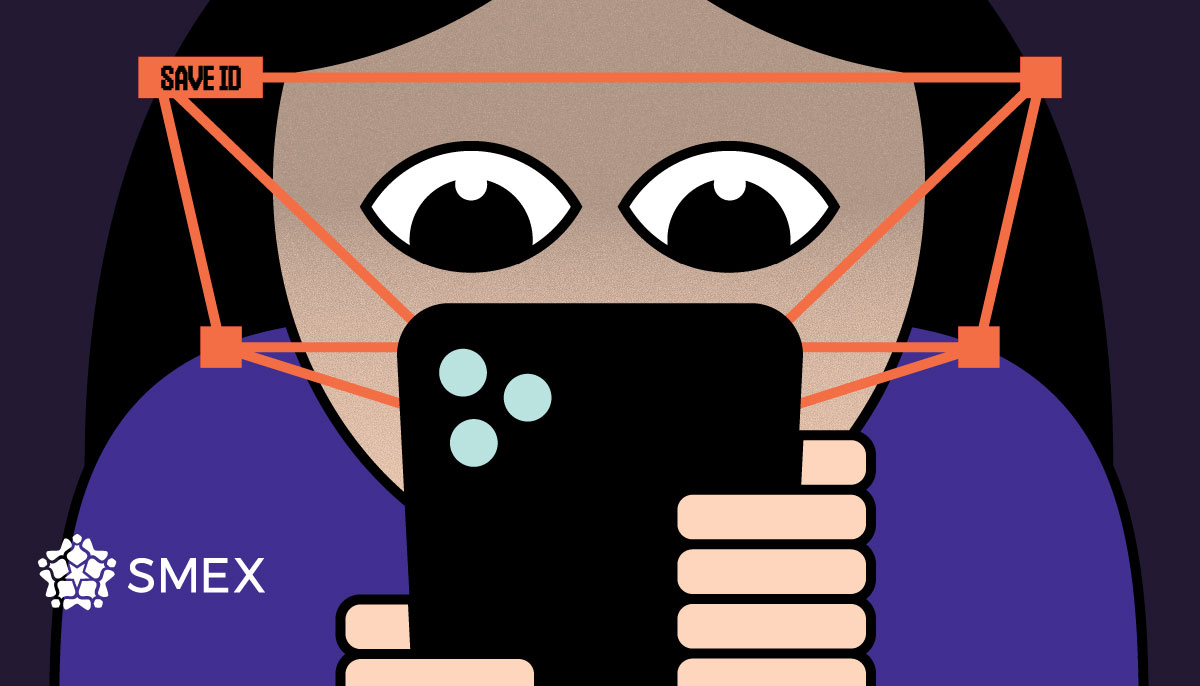
The featured image is an original illustration done by the SMEX team.