

The systems that govern speech online were not built for Arabic-speaking users. Women across the Arab world are paying the consequences.
Aliya Nasif was campaigning for re-election to the Iraqi parliament in October 2025, when someone used AI face-substitution tools to superimpose her face onto the body of a Ukrainian dancer in a video originally posted to TikTok in 2023. The resulting clip, framed as a pornographic scandal, was posted to X.
Amid Iraq’s 2025 election campaign, the Iraqi fact-checking platform Checker News, documented over 150,000 views on a single account. Multiple other pages amplified it across platforms. Nasif,a sitting member of parliament,publicly denied the video. A fact-check established the fabrication beyond doubt. The content remained.
Five years earlier, Lebanese Al Jazeera journalist Ghada Oueiss checked Twitter to find a private photograph that was stolen from her phone by circulating across the platform. Some had been altered to make her appear nude. Within twenty-four hours, more than 25,000 tweets, retweets, and replies had spread the content across the platform, driven predominantly by prominent Saudi-affiliated verified accounts. She reported the content, but the campaign continued.
In Yemen, seven women whose private images had been stolen and posted on Facebook to blackmail and humiliate them did not know how to file a complaint with the platform. One of the seven, a beauty salon owner in Aden, told Amnesty International that from the day the content went up, her life was “completely destroyed.” The blackmailer had created Facebook pages posting her pictures alongside fabricated images. She began psychological treatment. Her relationships with her husband’s family, her own family, and most of her friends collapsed. Her career of 11 years in the making was gone as she never returned to work.
Different countries, different women, three distinct forms of harm. What connects them is not geography, or politics, or law. What connects them is platform response, or rather the absence of one. That absence was built in. It shows exactly how these systems function and for who they serve.
According to UN Women, nearly half of women internet users in the Arab States do not feel safe online. Among activists, journalists, and human rights defenders, 70 percent report receiving unwanted sexual images or symbols, and 44 percent say the abuse has extended from the screen into physical spaces.
Meta, X, TikTok, and YouTube all maintain policies prohibiting hate speech, coordinated inauthentic behaviour, non-consensual intimate imagery, and certain forms of synthetic or AI-generated abuse.
The rules exist. The enforcement systems built to apply them do not function equally across languages and geographies. By 2024, the dominant platform response to AI-generated content had converged on labelling rather than removal, a posture that places the burden of detection on metadata and creator disclosure rather than on platforms themselves. The Nasif case shows where that posture could lead.
Researchers have documented this pattern globally: when AI is deployed against male candidates, the target is their political credibility; when deployed against women, it is their bodies. These are not equivalent harms.
The Oueiss case makes the mechanics of that failure visible. She had been covering the murder of Jamal Khashoggi, and her own lawsuit alleged that she was targeted by the same network implicated in his killing, not despite her journalism but because of it.. She reported the content to Twitter and described the response as too slow to interrupt the campaign’s velocity.
She later told ICFJ researchers that she had “lost count” of reports submitted to Facebook, Twitter, YouTube, and Google, none of which produced meaningful intervention.
A 2023 ICFJ analysis of over 151,000 tweets directed at her found that more than a year on, the abuse had not subsided. The platform’s automated detection tools were capturing roughly half of clearly abusive content:harassment embedded in images, videos, and GIFs was systematically evaded detection. As of February 2023, the original tweet sharing an abusive cartoon of Oueiss remained on the platform, restricted by age verification but not removed.
The failure operates at two levels. First, the speed: 25,000 interactions in 24 hours, documented in real time by researcher Marc Owen Jones, spread faster than any reporting system could intercept it. Oueiss told IPI that she reported the content to Twitter but received a slow response, which she said allowed the massive dissemination of the content to continue.
A reporting system that takes hours or days does not address coordinated harassment, it documents it.
Second, the verification paradox: Oueiss herself noted that the campaign was driven by “Twitter-verified accounts,” a credibility signal the platform had itself granted. Researchers and press freedom organisations have documented this problem repeatedly: state-linked actors exploit platform trust infrastructure. The system designed to establish authenticity was being used to lend institutional weight to a coordinated attack.
Oueiss filed a civil lawsuit against Saudi Crown Prince Mohammed bin Salman and several co-defendants. The case was dismissed on jurisdictional grounds. She returned to Al Jazeera. The platform that hosted the campaign continued operating without structural modification.
The Yemen cases show a different dimension of the same failure:basic accessibility. Not one of the seven women knew how to file a complaint on Facebook to have the content removed.The platform’s primary mechanism for user-initiated content governance was, for them, functionally invisible. All seven eventually had the content removed, but only because a local civil society organisation stepped in to do what Facebook had not.
Between 2023 and April 2024, the Yemeni Organisation for Development and Exchange of Technology documented 115 cases of online blackmail, the majority targeting women.By mid-2023, SANAD, a local digital rights organisation, was receiving at least four new cases daily, with 95 percent of survivors being women. These are only the cases that reached organisations equipped to help. When Amnesty International formally wrote to Meta setting out its findings, the company replied that it was unable to respond within the requested timeline and shared links to its publicly available policies.
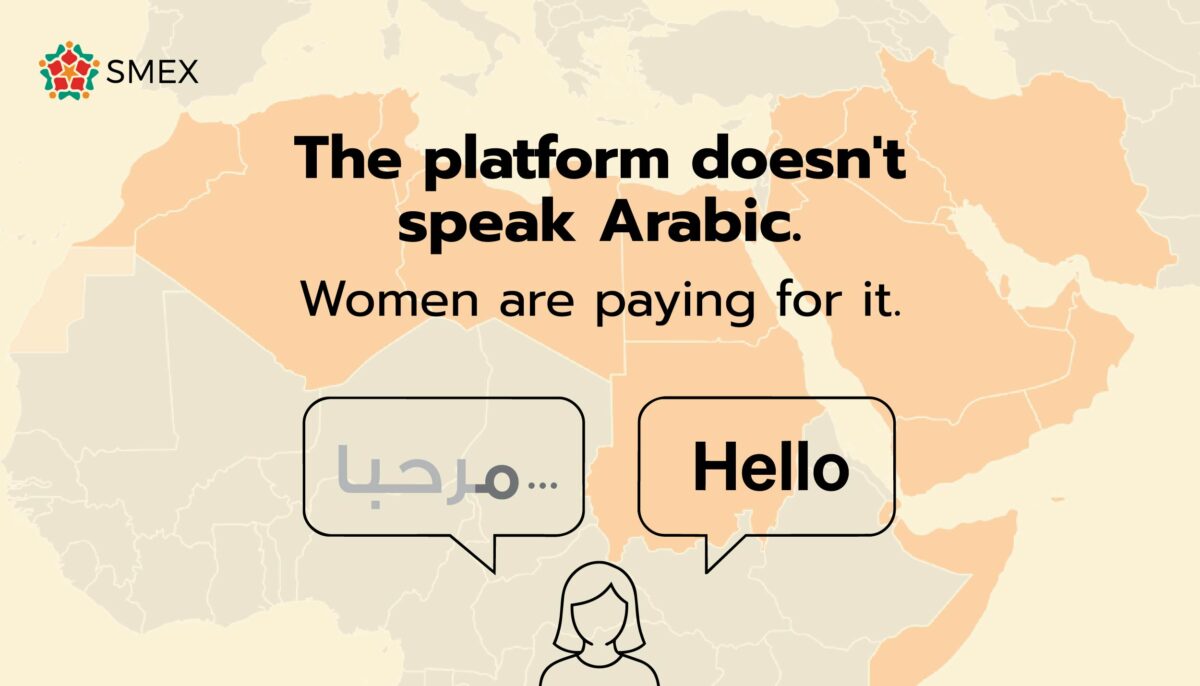
None of this is accidental. Arabic is among the most spoken languages on social media globally and among the most under-resourced in platform moderation infrastructure. The difficulty is partly linguistic, but it is also the result of a consistent set of choices about where investment flows.
Arabic has two distinct forms, the Modern Standard Arabic which is the formal register likely used in most training datasets, diverging significantly from the colloquial dialects in which most social media communication actually occurs. Automated systems trained on one register systematically misread speech produced in others.
A 2024 report by the Centre for Democracy and Technology found that Moroccan and Algerian dialects are not adequately represented in platform training data, resulting in systematic moderation errors. Research by the MADR network found that leading large language models perform poorly with Arabic.
Internal Meta documents, leaked in 2021 as part of the Facebook Papers,, showed that moderation algorithms had incorrectly flagged non-violent Arabic content in approximately 77 percent of cases in some contexts, with employees issuing repeated internal warnings that went unaddressed.
A 2025 analysis by SMEX found that medically accurate Arabic health content was being systematically removed while harmful content targeting Arabic-speaking women was not equivalently intercepted.
Platforms allocate moderation resources where regulatory pressure and advertiser scrutiny are greatest. That means English-language Western markets. Arabic-language users in the SWANA region sit at the periphery of that calculation, and they pay for the consequences in both directions, with legitimate speech removed and harmful speech left standing
The systems built to enforce these rules are doing so, showing that . they were not designed for this language, this region, or these users.
The CDT’s 2024 report is explicit on what fixing is required: investment in Arabic natural language processing that covers colloquial dialects, native annotators who understand regional context, and moderation teams that reflect the communities they serve.
Reporting mechanisms accessible to users who are not digitally fluent in English are an equally basic requirement. The EU’s Digital Services Act has shown what regulatory pressure can produce.In its first two years, it reversed over 50 million content moderation decisions and granted researchers and civil society unprecedented access to platform data. No equivalent framework exists yet across the SWANA region. Building one through regional regulatory coordination, civil society engagement in platform governance, and systematic public documentation of failures, is a political task as much as a technical one.
A reporting mechanism that none of seven women knew existed is not a safety measure. A moderation system that cannot read the language in which harm is conducted is not a content policy. And a response that arrives after a campaign has already run its course is not a remedy. The women documented here will not be the last to discover this. They are just the most recent.