

At the outset of Israel’s war on Lebanon, a Beirut coffee shop used its kitchen for a relief efforts, churning out roughly 1,400 meals for forcibly displaced people in shelters. The effort runs on small donations, funneled through the Whish Money app. But there’s a hitch: transfers often fail, disrupting a fragile, crowd-funded lifeline just as demand spikes.
The cafe’s Operations Manager, Khodr Al-Akhdar, tells SMEX that “donation transfers are often rejected by the company, even when the amounts are small and do not exceed ten dollars.” He also notes that most of the rejected transfers originate from the United Kingdom. Transfers from the United States tend to go through but only after several attempts, while transfers from within Lebanon are processed normally.
In November of 2025, Whish Money launched an international transfer service, allowing users to send money directly from the app to bank accounts and digital wallets in more than 70 countries.
Al-Akhdar contacted the company’s customer service, which said that it was “not responsible” for the rejected transactions because the refusal originates from the sending country.
This is not the first time such issues have been reported. In October 2025, Whish Money shut down the account of “Wataawanoo,” an association, which had been active since the end of the war in 2024. It collects donations for rebuilding destroyed homes and provides temporary education centers in border towns.
In a statement, the association said: “We were surprised by the Whish Money’s recent decision to close our donation account, despite submitting all the required documents to reactivate it. This has put our plans and projects, particularly in border villages, at risk of coming to a halt.”
While the company did not disclose the reasons behind this decision, an economic expert, who chose to remain anonymous, told SMEX that the move likely stems from Circular No. 170 issued by Banque du Liban (BDL), Lebanon’s central bank. It may also be an act of compliance to central bank restrictions, as well as adherence to international sanctions, particularly those imposed by the United States.
Fraud Targeting App Users
Like other digital wallets, Whish Money has become a platform for fraud attempts that have affected many users.
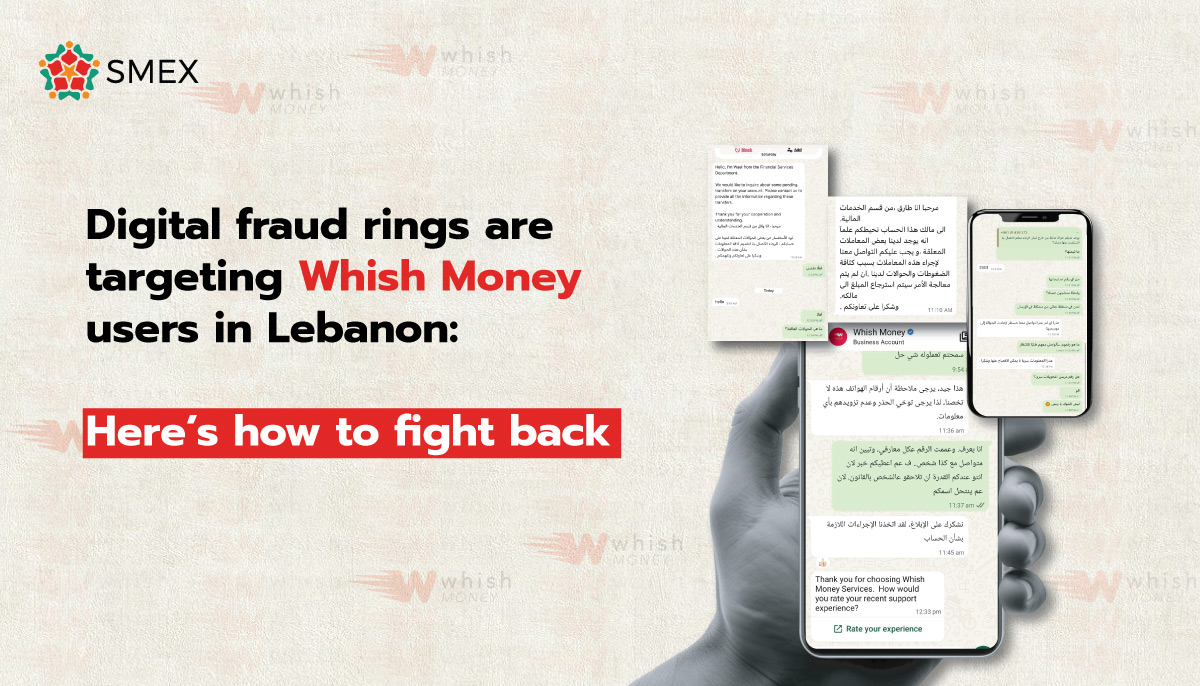
Iman Barq, a resident who has been fundraising for displaced people, says that she received a WhatsApp message from an unknown number, claiming to be “Tarek” from the Customer Service department at Whish Money.
“Tarek” asked her to contact him “to complete certain transactions due to the high volume of transfers and pressure on the system,” adding that “if the matter is not resolved, the funds will be refunded to the account holder.” Barq says she quickly realized it was a scam: “I threatened I’d circulate his number, and he immediately blocked me.”
Barq then proceeded to contact Whish Money’s support team, which advised her not to share any information with the scammer and confirmed that the company had taken the necessary measures regarding the account.
After she shared the details of the incident on her Facebook page, another person crowdfunding for displaced people reached out with a similar scam attempt. This suggests a pattern of fraudsters targeting individuals involved in fundraising and aid distribution.
A few days later, Barq’s colleague in the fundraising campaign was also faced with a similar scam attempt, but from a different number. She engaged with the scammer, who tried to lure her by falsely claiming she had received a transfer of USD $230.
Impersonating the Application
Another type of fraud has also appeared through paid advertisements of a Facebook page named “Whis lb,” which uses a logo similar to Whish Money’s and claims to offer financial services via a Visa card. The page has reportedly been taken down.
A user on Reddit reported being the victim of fraud, with around 20 purchase transactions carried out using their Visa card within minutes. These transactions included subscriptions, attempts to spend large amounts at jewelry stores, purchases from a phone shop in Taiwan, and even payments through the Canadian immigration website.
The user noted that while some of these transactions were declined, others were successfully processed.
The account holder explains that they immediately reached out to the company, where staff asked them to contact technical support. But after reaching out to the company’s support team via WhatsApp, they refused to investigate or refund the transactions, instead asking the user to “contact the merchants,” which they described as “illogical.”
SMEX attempted to contact Whish Money for comment on these incidents, but the company chose not to respond to the inquiries.
The Need for Preventive Measures
In light of the growing number of fraud attempts, driven by the expansion of e-commerce and an increasing reliance on digital wallets, SMEX’s Digital Safety Helpdesk recommends a set of preventive measures when using Whish Money or similar financial services.
These precautions are particularly important given the rise in scams targeting individuals involved in fundraising and humanitarian assistance.
- Do not share any personal or financial information with anyone who contacts you via WhatsApp or phone claiming to be from customer service, including verification codes, account details, or bank card numbers.
- Always verify the identity of the contacting party through the company’s official channels, and do not trust messages that use pressure tactics or threats, such as canceling a transfer or returning funds within a short timeframe.
- Be cautious of fake pages and accounts on social media, especially those using names and logos similar to the original company or promoting unreliable financial services and offers through paid advertisements. Avoid clicking on links from unknown sources, and only enter financial information through the official app or verified website. In case of suspicious messages, it is advisable to document them through screenshots and report them to the company and the platform used, while warning others, especially if they target individuals working in relief or fundraising.
- Regularly monitor financial transactions, enable instant withdrawal and payment notifications, and contact the bank or card issuer immediately if any unknown transaction is detected, requesting that the card be frozen immediately. It is also recommended to use strong and unique passwords and to activate additional security measures whenever that option is available to reduce the risk of unauthorized access.
- When possible, dedicate a secure phone number and email address to financial accounts, and avoid using them widely on social media to reduce exposure to targeting. It is also advisable not to keep large amounts in digital wallets for extended periods and to limit usage to necessary amounts only, minimizing potential losses in case of fraud or account compromise.
- Verify the recipient’s name and phone number or account details before confirming any transfer, and avoid rushing to send money in response to urgent or emotionally charged appeals without confirming the legitimacy of the beneficiary.
Our recommendations to digital wallet providers
SMEX calls on digital wallet providers in general, and Whish Money in particular, to adopt measures that strengthen customer protection. These include:
- Improving user support mechanisms and enhancing response times.
- Adding advanced security layers to protect accounts and transactions.
- Providing effective services for reversing or freezing transfers, especially in cases of error or fraud.
- Taking strict action against accounts involved in fraudulent activities or using false identities.
- Enhancing transparency and facilitating communication channels with users.
- Publishing a detailed privacy policy outlining how data is collected and processed.
- Giving special attention to the protection of sensitive and personal data, particularly in light of breaches affecting both public and private institutions in Lebanon.
- Complying with the highest standards of data protection and privacy, including adherence to the provisions of Law No. 81 on Electronic Transactions and Personal Data, as well as the General Data Protection Regulation (GDPR).